
Changing the Rules: Why NZ First’s Attack on Voting Rights Hurts All of Us
Behind the Theater: How NZ First is quietly stripping away Kiwi voting rights.

By Dr Harpreet Singh | drhsinghnz.substack.com | FB: @DrHSinghNZ | BSky: @DrHSinghNZ | IG: @DrHSinghNZ
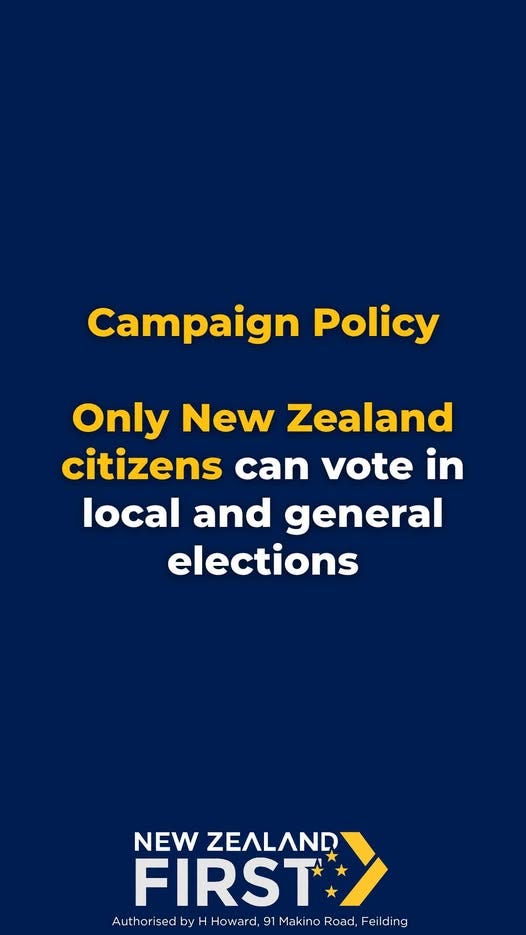
NZ First has always campaigned as the party of stability, the “handbrake” designed to protect our long-standing traditions from radical change. But the party’s latest 2026 campaign announcement to strip permanent residents of their voting rights does exactly the opposite. It is a direct attack on a foundational part of our democracy that has worked quietly and successfully for over 50 years.
Spotlight: The 1975 Consensus Under Attack
To understand why NZ First’s current campaign policy is such a radical departure from Kiwi tradition, we have to look back to the Electoral Amendment Act 1975.
The mid-1970s marked a milestone in the maturity of our democracy. Parliament moved away from old colonial definitions of who “belonged” and established a simple, fair principle that has stood unchallenged for over 50 years: if you live here permanently, pay taxes, and contribute to our community for a year, you earn a stake in the democracy.
Before 1975, voting was tied to archaic imperial rules requiring you to be a “British subject.” The 1975 law scrapped this, recognising that long-term residents are a core part of the Kiwi fabric. By targeting this five-decade-old consensus, NZ First isn’t protecting tradition; they are actively rolling the clock back half a century to shrink our voter base to their advantage.
Shifting the Goalposts on New Zealanders
Under current electoral law, permanent residents who have lived here continuously for a year or more are required to enrol and are allowed to vote. These are people who have committed to New Zealand. They live here, work here, pay taxes, raise families, and contribute to our communities.
By demanding “citizens-only voting,” Winston Peters is trying to turn a basic democratic right into a prize reserved only for those who have navigated a lengthy, expensive bureaucratic process.
This isn’t just a minor tweak to the law; it is a major constitutional disruption. Consider what this policy actually achieves:
Silencing Local Voices: It takes the vote away from long-term residents, including many across our Pasifika and migrant communities, who are deeply invested in the future of their local suburbs and schools.
Fixing a Problem That Doesn’t Exist: Our electoral system is internationally respected for its fairness, cleanliness, and stability. There is no evidence that resident voting has ever compromised a New Zealand election.
Politicians Choosing Their Voters: A healthy democracy means the public gets to grade politicians' performance. This policy flips that logic on its head, letting politicians handpick who is allowed to judge them.
Part of a Wider Trend
This latest announcement follows a worrying pattern of chipping away at democratic access. In 2025, the coalition passed the Electoral Amendment Act, which banned same-day voter registration, requiring people to enrol at least 13 days before the election, and introduced several other regressive changes. The Act reinstated a blanket voting ban on prisoners serving sentences under three years, prohibited the distribution of food and drinks near polling booths, and raised the threshold for anonymous political donations. Together, these changes create unnecessary bureaucratic hurdles that disproportionately lock out youth, Māori, Pasifika, and transient communities, reversing decades of progress aimed at keeping our ballot box inclusive, transparent, and fair.
For decades, New Zealand has led the world in making voting simple, transparent, and accessible to everyone who calls this country home. Winston Peters's restriction of the ballot box doesn’t make our nation safer or more stable. It simply makes our democracy smaller, weaker, and less representative of the people who keep our economy running.
If we want to protect our way of life, we should encourage more people to participate in our democracy, not lock the door from the inside.
Winston Peters would argue that permanent residents who don't want to become citizens are not "committed to New Zealand" and therefore do not deserve the right to vote. After all, the right to vote is the right to tell other New Zealanders who should govern them. That is a privilege that should not be given lightly, if at all.
Winston Peters has a point. Immigrants from China and India, for example, often choose not to become New Zealand citizens because they wish to retain citizenship in their country of origin. Their primary loyalty is to their home country, where they do enjoy all the normal rights of citizenship, including the right to vote. If that is their choice, so be it.
However, immigrants from the US, UK, Australia, Canada and South Africa can have dual citizenship. They can become New Zealand citizens while their primary loyalty remains to their country and people of origin. They are no more committed than the immigrants from China or India who do not become citizens and do not get the vote. They just benefit from a set of circumstances that have their origin in the old imperial order in which British subjects enjoyed the same civil rights and political privileges wherever they resided within the territories of the empire.
So what is the solution? Giving all foreigners resident in the country the right to vote is not an appropriate response. From the point of view of Aotearoa (the nation state to be once colonialism is eliminated) the appropriate response would be to deny the right to dual or multiple citizenship. That would put immigrants from China, India, the US, UK, Australia, Canada and South Africa on an equal footing. They would all have to choose, and to be committed in their choice. But there would be none of this crazy, discriminatory nonsense of requiring immigrants to swear allegiance to a British monarch in order to qualify as New Zealand citizens. That would remove a serious moral impediment to choosing New Zealand citizenship.
The only good thing for a NZ immigrant, if you still have citizenship from the country you left, you can be deported from NZ if you break a serious law.